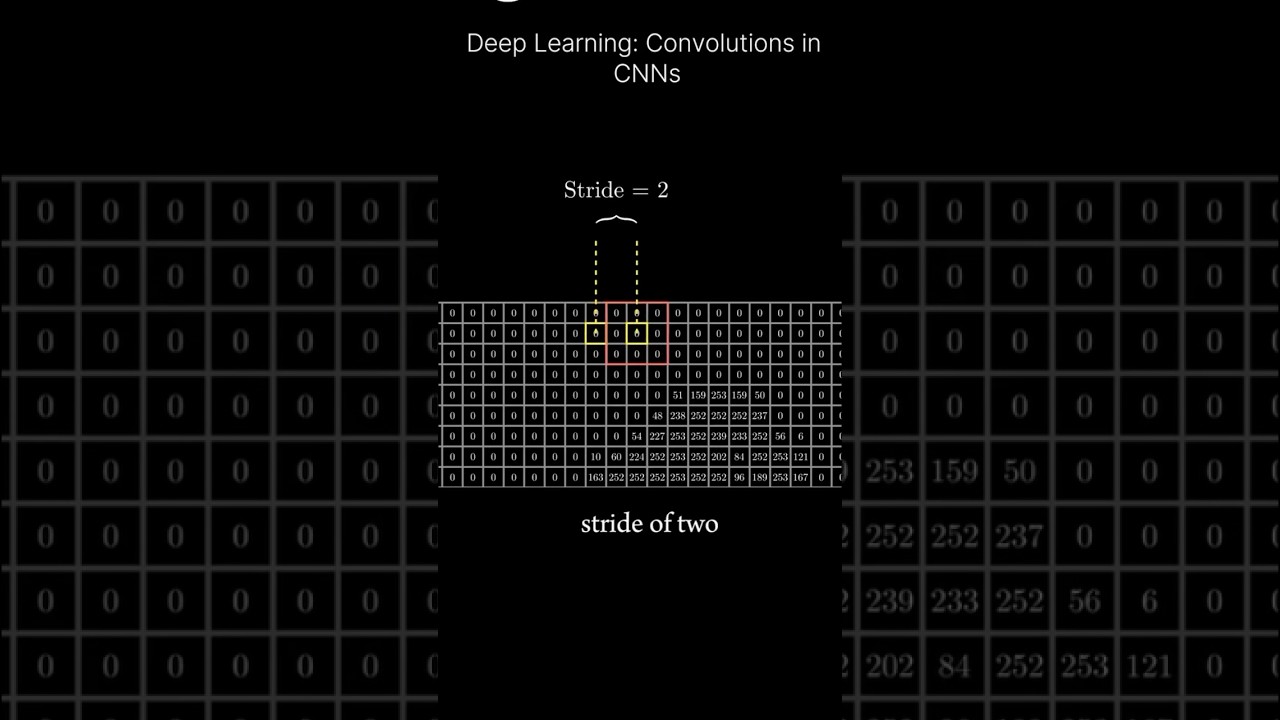
Convolutional layers use math operations called convolutions to extract visual features from input data. These layers have three key parameters-kernel size, stride, and padding.
The kernel size determines the dimensions of the filter that slides over the input (3×3, etc.). Each value in the kernel matrix has a weight, which detects patterns like edges or textures when used in a weighted sum. The standard kernel size is 3×3, although there have been certain cases where a larger size has shown better performance.
The stride is how many pixels the kernel moves per step. A stride of 1 moves the kernel one pixel at a time, while a stride of 2 skips pixels.
Padding adds extra pixels (usually zeros, called zero padding) around the input to control the output dimensions. Without padding, the feature maps will be smaller than their inputs with each convolution. Padding can allow the output to match the input size, allowing the kernel to process edge pixels better, preventing information loss near the edges.
C: Deepia
Join our Al community for more posts like this @Giffah_Alexander
#deeplearning #machinelearning #neuralnetworks #computerscience #education #CNN #convolution #datascience #math #mathematics #python #ai #dataanalytics #artificialintelligence #data #programming #bigdata #coding #technology #datascientist #tech #dataanalysis #datavisualization #analytics
source