
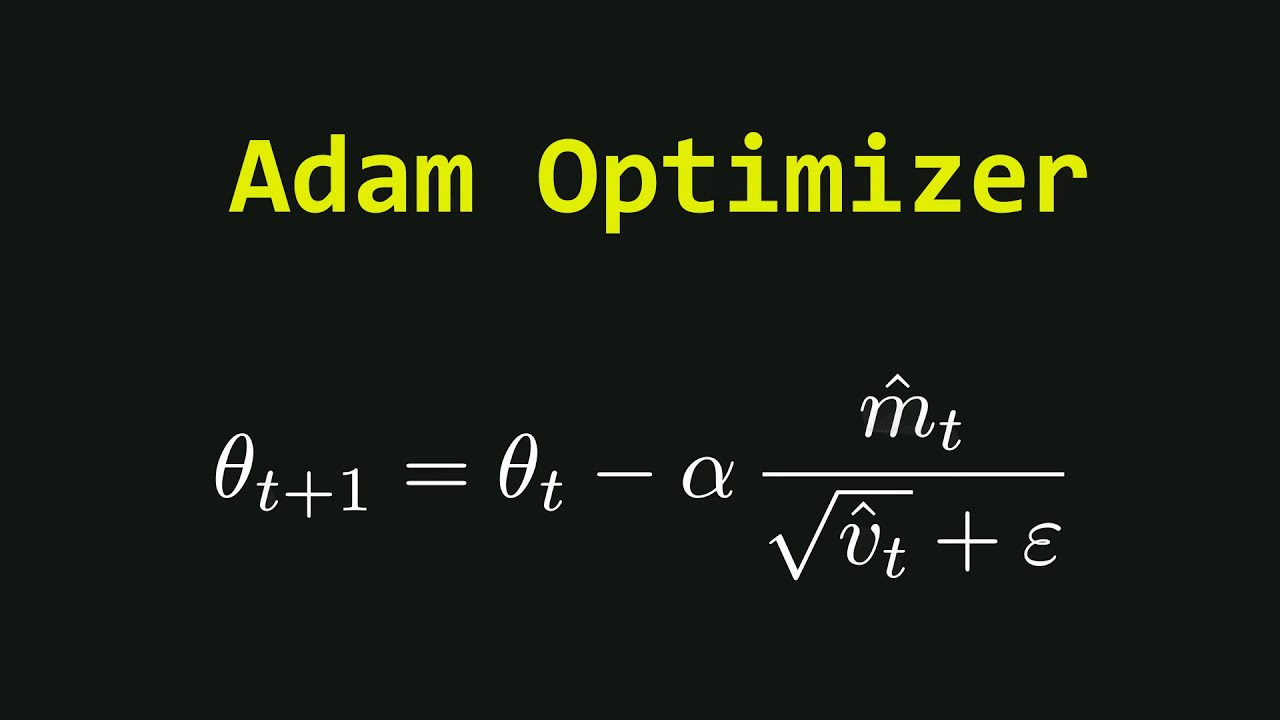
In this video, you’ll learn how Adam makes gradient descent faster, smoother, and more reliable by combining the strengths of Momentum and RMSProp into a single optimizer. We’ll see how Adam uses moving averages of both gradients and squared gradients, how the beta parameters control responsiveness, and why bias correction is needed to avoid slow starts. This combination allows the optimizer to adapt its step size intelligently while still keeping a strong sense of direction. By the end, you’ll understand not just the equations, but the intuition behind why Adam has become one of the most powerful and widely used optimization methods in deep learning.
Links for Important videos ✅ :-
EWMA:- https://youtu.be/dlajqZn7bjM
Gradient descent :- https://youtu.be/2xdUsy3oq-4
RMSProp:- https://youtu.be/MiH0O-0AYD4
Momemtum Gradient descent:- https://youtu.be/Q_sHSpRBbtw
Data Normalization:- https://youtu.be/W2vqsTg-rDU
📚 Welcome to the Channel!
If you’re passionate about learning complex concepts in the simplest way possible, you’re in the right place. I create visual explanations using animations to make topics more intuitive and engaging—especially in Algorithms, AI, machine learning, and beyond.
🎥 Animations created using Manim:
Manim is an open-source Python library for creating mathematical animations. Learn more or try it yourself:
🔗 https://www.manim.community
Let’s Connect:-
GitHub:- https://github.com/ByteQuest0
Reddit:- https://www.reddit.com/r/ByteQuest/
source

Leave a Reply