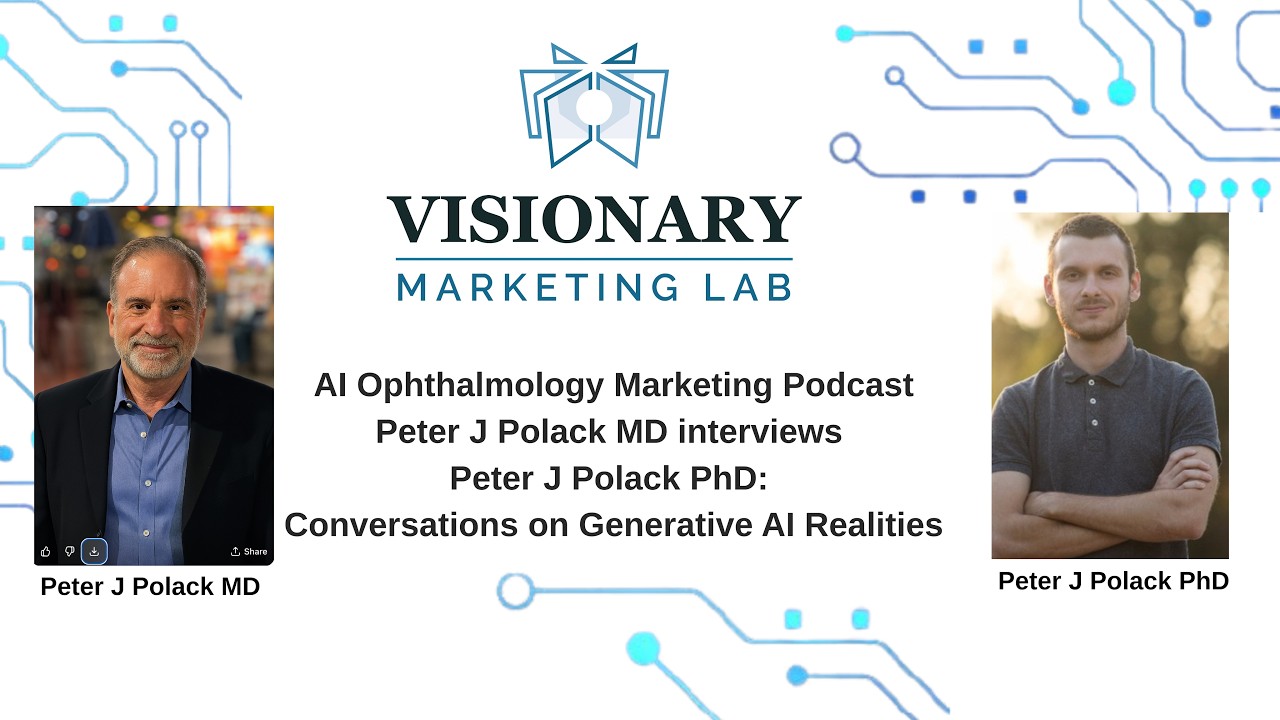
In this deep, thoughtful conversation, Peter J. Polack, MD interviews Peter J. Polack, PhD (Georgia Tech Masters in AI, UCLA PhD in Information Studies) about the true state of generative AI—beyond headlines and hype.
The State of Generative AI
Generative AI has existed in usable form for about five years—but recent fine-tuning has dramatically improved precision in text and image generation.
Is it getting better?
Yes. Rapidly.
But improvement doesn’t eliminate limitations.
Drift & Hallucinations
What are they?
• Hallucinations: AI produces content that wasn’t intended—sometimes inventing facts.
• Drift: As AI-generated content enters training datasets, feedback loops may subtly degrade precision over time.
Because models work probabilistically, strange outputs aren’t bugs—they’re statistical edge cases.
“No Free Lunch” in AI
Why not just use models with real-time data like Google Gemini?
In machine learning, every gain comes with a tradeoff:
• Speed vs robustness
• Recency vs refinement
• Capability vs stability
There is no perfect model.
Capability Overhang & Black Box Complexity
Modern LLMs are layered compositions of multiple models. Even developers struggle to fully trace why specific outputs occur.
The systems are powerful.
They are also increasingly opaque.
Using AI in Medicine & Education
For medical practices creating patient education:
You must think like a statistician.
AI may work 99.5% of the time—but the 0.5% matters.
Always verify. Especially in healthcare.
The Environmental Cost
Data centers powering AI:
• Massive energy usage
• Increasing CO₂ impact
• Water and grid strain
• Rapid expansion into local communities
Some estimates suggest AI-related emissions rival major metropolitan outputs.
Meanwhile, costs are rising.
The Quiet Shift: Free → Premium
Developers are already seeing:
• Quality reductions in free models
• Premium-tier gating
• Increasing subscription layers
The “free AI” era may not last.
Artificial General Intelligence (AGI)
Can probabilistic language models become truly intelligent?
Current LLMs analyze word relationships—not meaning itself.
Achieving deeper reasoning would require a fundamentally new direction, not just more data.
Is AGI impossible?
No.
Is it likely under current incentives?
Unclear.
Existential Threat or Overhyped Fear?
The real risk may not be AI becoming sentient.
The bigger threats:
• Market incentives overriding environmental caution
• Automated systems authorized to act
• Vulnerability exploitation at scale
The threat is structural, not cinematic.
Simulation Theory?
Are we living in a virtual reality?
Perhaps less important than the incentives behind promoting that idea.
Final Takeaway
AI is not static.
Costs are changing.
Capabilities are shifting.
Regulation is likely coming.
If you use AI:
• Stay vigilant
• Verify outputs
• Monitor evolving pricing models
• Understand the environmental footprint
• Expect rapid change
The rug can be pulled at any time.
for more related information on AI Augmented Ophthalmology Marketing, visit us at www.visionarymarketinglab.com
source